On October 22 USDA named the first eight projects under its new FIELDS program, which puts Commodity Credit Corporation money behind domestic fertilizer manufacturing. USDA’s share is about $573 million in proposed funding, against more than $1.34 billion in total proposed investment. Half of the projects make nitrogen. The others cover sulfate of potash, sulfur, a multi-nutrient blend and fertilizer from farm byproducts.
None of the eight is in Colorado. The closest to us are a sulfate of potash plant near Carlsbad, New Mexico, a manure-based nitrogen project in Kansas, and small modular ammonia units at sites that include Nebraska and South Dakota. USDA’s own economic analysis estimates the added output could bring nitrogen prices down 4.4 percent and potash 5.3 percent once the plants are running. USDA gave no date for when any of them will start producing, so these are selections, not plants. Budget 2027 fertilizer on today’s market.
This program funds manufacturers. There is nothing for growers to apply for. Dollar figures and price estimates are USDA’s, from its October 22, 2026 release (No. 0139.26). CCGA administers no USDA program.
We are planning the annual meeting, and rather than decide where to hold it and what to talk about in a room by ourselves, we are asking the people who would have to drive there. Sterling, Yuma, Burlington, or write in the town that works.
Then tell us what would actually be worth 2 hours of your valuable time: FSA programmes explained and how to use them, marketing with AI, or making the bank work for you — an inside look at what an ag lender needs to see, from people who make those decisions.
About a minute, no name required, and the answers go to the board and nowhere else. There is a blank box for anything we missed, and it is the part the board reads first.
NASS corrected its September corn data on October 23 after a processing error reached Kansas, Nebraska, the ten-state averages and the national forecast. Nebraska’s September yield went from 177 to 182 bushels, Kansas from 121 to 118, and the national September figure from 178.5 to 178.8. The October forecast was left unchanged at 181.2 bushels, which is where the argument is.
New: in a follow-up notice on October 24, NASS confirmed what went wrong. The wrong acreage weights were used when it combined irrigated and non-irrigated field samples. That is the dryland-versus-irrigated question Colorado has been raising for years, now in USDA’s own words. The same day, USDA signed an agreement with NASA to bring more satellite data into its yield and acreage estimates.
Colorado was not among the corrected states, which is not the same as being unaffected. In September roughly 90 percent of the Nebraska fields sampled were non-irrigated; in October the mix was back to about half irrigated. The irrigated and dryland split is the whole shape of the crop in this state — and it is the thing our T-yield and PLC yield fights have always been about.
The part nobody is saying out loud: the Harvest Fuel Relief formula runs on WASDE yields, and those rates land in November.
Linking a Login.gov account to your USDA customer record takes a few minutes, costs nothing, and is the difference between a pre-filled application and a blank form at the county office. It is also the only useful thing anyone can do about Harvest Fuel Relief today, since rates are not out and the window is not open.
Three steps, in an order that matters — most of the trouble people report comes from doing step two before step one. Plus what to do when the record will not link, which happens to producers who have farmed with FSA for thirty years and is not your fault.
USDA will put $8 billion into one-time payments for the 2026 harvest, announced October 19 by President Trump alongside Secretary Rollins. The money comes from CCC funds, FSA will administer it, and crop insurance enrollment is not required. It is aimed at what diesel has done to this year’s cost of production.
It is also, today, a program with no payment rate and no application window. Rates for Title I commodities are expected in November. Anyone quoting a per-acre figure right now is guessing. What we can say is that both comparable programs — Farmer Bridge Assistance and ECAP — paid a flat rate per acre by commodity, and under that structure a Colorado acre draws the same as an Iowa acre, which is the opposite of how ARC and PLC treat this state.
One thing worth doing today: link a Login.gov account to USDA. It is free, and it is the difference between a pre-filled application and a blank one.
For the 2025 crop year, producers receive the higher of their ARC-CO or PLC payment regardless of which they elected. It is the most sensible thing to happen to the commodity title in years — and it expires after one season. For 2026 growers are back to guessing.
The election is made before planting, before the weather, before the market. Guess right and you are covered; guess wrong and you are not, through nothing inside your control. That gap is wider on Colorado dryland than in the Corn Belt, because our yields swing harder — so the producers most exposed to the guess are the ones with the least predictable ground. CCGA is working the conference to get the provision extended.
The executive order signed in Grand Island on October 5 lets off-road dyed diesel run on the highway and defers the 24.4 cent federal excise tax through the end of the year. For an operation hauling its own grain that is real money — Secretary Rollins put the projected savings to farmers at roughly $640 million.
Two things the headlines leave out. Deferred is not forgiven — eliminating the obligation would take further action and most likely an act of Congress, so 5,000 on-road gallons is about $1,220 carried as a balance, not saved. And Colorado’s own 20.5 cent special fuel tax is a separate question that an executive order does not reach.
Three outside sources worth your time, with what each is good for. AFPC at Texas A&M builds the representative farm models Congress leans on, and runs the free ARC/PLC decision aid with a staffed helpdesk — use it to work your own numbers before December 11. Southern Ag Today is a free daily written by extension economists from thirteen land-grant universities. Farm Policy Facts is the national coalition assembling the case for farm policy when it comes under attack in the press.
Each entry carries the pieces worth starting with and links straight through to the original. We summarise; we do not reproduce.
Growers ask us who is actually fighting for them. These are the officials who have shown up — who took the meetings, moved the bills, and did the unglamorous committee work that decides whether a farm program reaches this state or stops at the Kansas line. Rep. Boebert on the permanent disaster title. Sen. Bennet on two bipartisan farm bills and more Colorado listening sessions than anyone could ask for. Sen. Simpson, who runs a water district for a living. Chairman Boozman on the bill carrying permanent E15, Sen. Hoeven alongside him, and Chairman Thompson on the first H-2A reform in forty years.
And a request: these offices hear from growers when something goes wrong and almost never when something goes right. If one of them helped your operation, call and say so — then ask them to finish the job.
Colorado plants 1.46 million acres of corn against a national crop of roughly 90 million, and sends 8 members to a House of 435. That arithmetic is the whole reason this association pays dues to a five-state council. Together, Texas, Oklahoma, Kansas, New Mexico and Colorado hold 58 House seats and 10 Senate seats — and share the heat, the drought and the dryland acres the Corn Belt does not.
What the affiliation has actually delivered, with the receipts: the T-yield adjustments CCGA carried to the SWCA board and the council took to RMA, which raised transitional yields for corn across Colorado — nonirrigated corn in Yuma County alone went from 43 bushels to 60; and the excessive heat case that took Colorado’s disaster eligibility from 24 drought counties to statewide.
ARC and PLC payments for the 2025 crop start after October 1, and they are the largest in years because the reference price increases passed through reconciliation are finally reaching farmers. The per-acre averages circulating around the southern plains are weighted toward irrigated Texas Panhandle acres and overstate what most Colorado corn base pays. Here is the national rate, the formula, the PLC yield trap that catches people, and why we will not repeat a payment date we cannot source. Plus the 2026 election and enrollment window, which closes December 11 — and the trap inside it, since enrollment is required even if you change nothing.
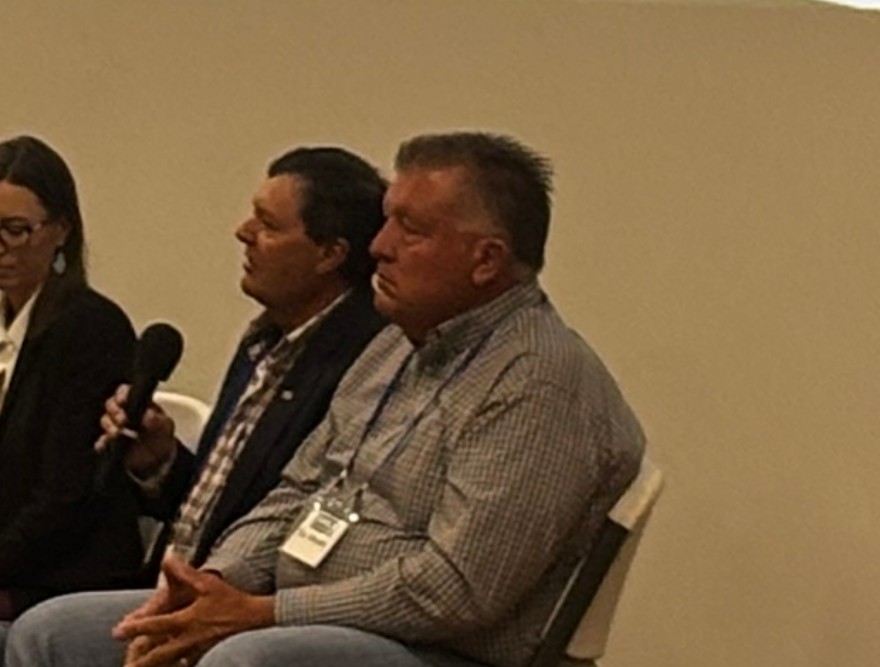
President Jeff Self represented Colorado corn on the Commodity Panel — Row Crop Perspectives, alongside cotton, sorghum, wheat, rice, peanut and corn leaders from across the region. He raised the regulatory pressure Colorado growers are spending their year fighting — pollinator measures, restrictions on treated seed — and thanked SWCA for being an organization built by people who know that farming in the West is not farming in the Corn Belt.
The panel’s shared diagnosis was a farm economy squeezed from both ends. USDA forecasts about $917 an acre to plant corn in 2026, up $27, which is north of $5 a bushel to break even at national average yields; the September WASDE puts the season-average price at $4.80. A price that improved is still below the cost of growing the crop, and dryland acres spread that same cost over fewer bushels. The line the room kept returning to: there is no one-size-fits-all policy for producers in America.
Also on the page: the day’s agenda, Dr. Darren Hudson’s market overview, the AFPC economists, the Capitol Hill staff panel, and the livestock session — where the cattle herd sits at a 75-year low and the feed demand behind our corn is the thing worth watching. Cost and price figures are USDA’s. CCGA administers no USDA program.
Colorado has two corn organizations and growers mix them up constantly. The penny-per-bushel checkoff funds research, markets and education — and is prohibited by law from spending a cent on policy. Every federal program paying out this fall exists because somebody advocated for it, and that work is funded entirely by growers who choose to pay for it.
SDRP sign-up closes September 30 and there is no further extension — applications can go in by fax, email or electronically, not just in person. The farm bill extension expires the same day, but the Senate floor vote has slipped to November, so expect a patch rather than a finished bill. ARC and PLC payments begin in early October, larger than recent years because the reference price increases enacted through budget reconciliation are now reaching farmers. And the $12 billion figure going around belongs to the Farmer Bridge Payments, announced last December and paid out in the spring.
USDA extended the SDRP application deadline a second time, to September 30, 2026, for both Stage 1 and Stage 2. The payment factor holds at 70%. FSA also added flexibility on how 2023–2024 quality losses can be documented — and warned that producers still waiting on FSA to generate a Stage 1 quality loss application must file by the deadline anyway.
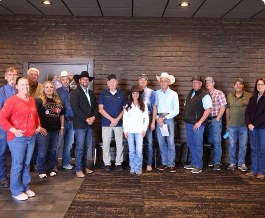
Colorado producers and CCGA leadership with Rep. Lauren Boebert at the agriculture round table, Cow Palace, Lamar.
CCGA was at the table when Rep. Lauren Boebert convened an agriculture round table at the Cow Palace in Lamar. President Jeff Self and Past President Dave Cure made the case for writing a permanent disaster program into the farm bill — a standing program that reaches producers who actually take a loss, without propping up operations that sustain none. A permanent program would also give producers something they can plan against, instead of waiting on an ad hoc bill after every disaster.
A Cheyenne County judge blocked Xcel from condemning farmland for a power line serving its own wind farms, and dismissed the case. Xcel has appealed to the Colorado Supreme Court. The outcome sets the baseline for what every eastern Colorado landowner can ask for when energy infrastructure crosses their ground. Both sides laid out for member discussion — CCGA has taken no position.